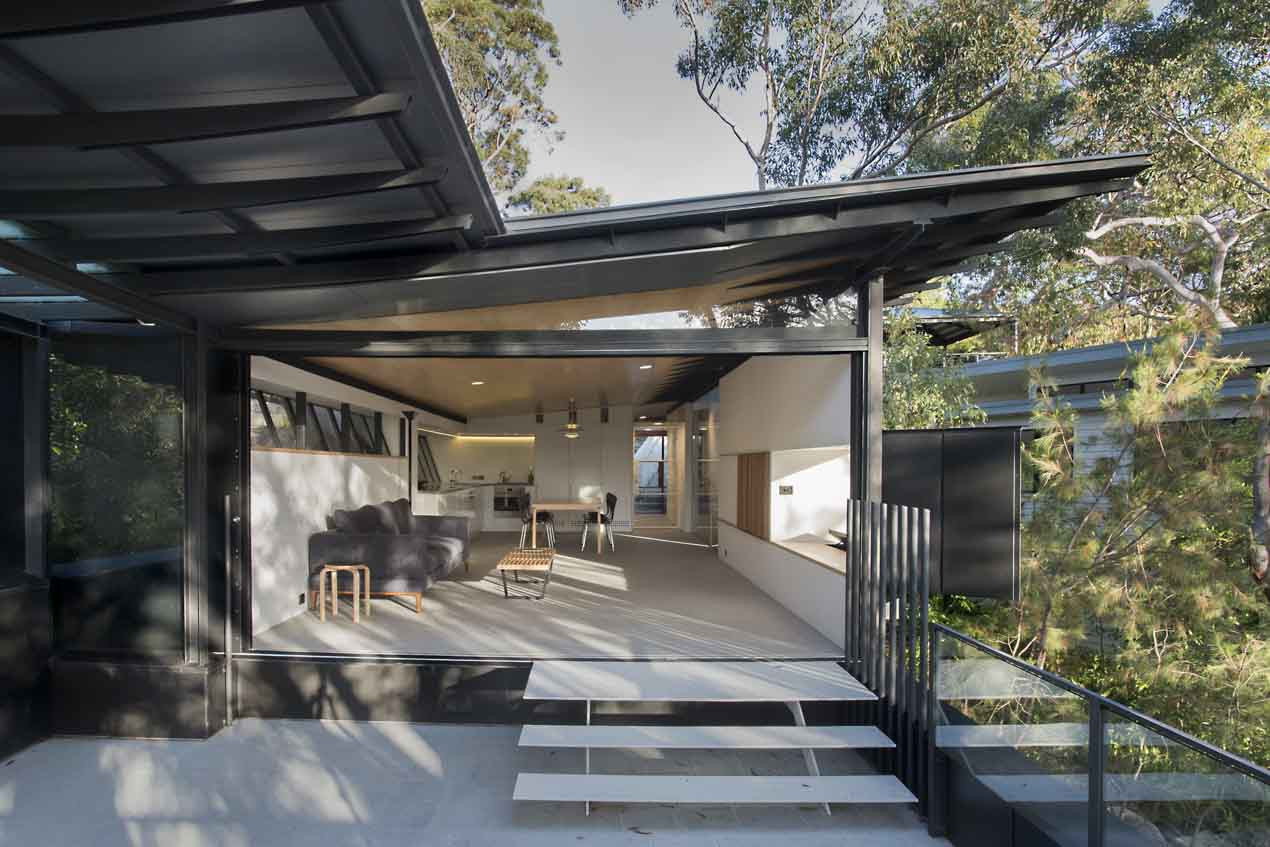
Glenn Murcutt is an award winning Australian architect best known for his innovation in designing climate-responsive buildings. He pioneered the development of Australian environmental design in private housing, paying specific attention to the way that architecture can influence and be influenced by the landscape.
Glenn Murcutt was born in London, England in 1936 and lived on the coast of Papua New Guinea for most of his early years. In 1941, he attended Manly Boy’s High School in Sydney before continuing to study architecture at the Sydney Technical College (now the TAFE New South Wales Sydney Institute). Murcutt currently lives in Sydney with his third wife Wendy Lewin, who is a fellow architect and a founding member of the Australian Architecture Association. Glenn Murcutt had two sons; Daniel and Nick Murcutt. Nicholas, also an architect, founded the Neeson Murcutt architecture firm. Nicholas passed away in 2011, aged 46, and younger brother Daniel Murcutt has since become an advocate for cancer research.
Story continues below advertisement
After his 1961 graduation from Sydney Technical College, Murcutt spent the next eight years at renowned Sydney firm Ancher, Mortlock, Murry and Woolley. In 1969 he began his own practice operating out of the Sydney suburb Mosman, while also teaching design at the University of Sydney. The first official recognition of Murcutt’s rare talent came in 1992 when he was awarded the RAIA Gold Medal by the Australian Institute of Architects. The criteria for this award include:
Despite working exclusively in Australia, Murcutt was awarded an equivalent Gold Medal by the American Institute of Architects in 2009 for his “profound impact on Architecture throughout the world.” These are just two of many symbols of Murcutt’s influential approach to architecture worldwide; Murcutt made history as the first Australian to ever win the Pritzker Architecture Prize in 2002, generally regarded as the most prestigious architectural prize in the world. Some of his other most notable awards include
Murcutt is known for his iconic design philosophy, “touch the earth lightly,” an Aboriginal proverb which takes center-stage in all Glenn Murcett designs as he seeks to create sustainable buildings which work in harmony with the Australian environment. Many of his architectural choices are influenced by his upbringing in Papua New Guinea, where his family home was a testament to the unique landscape – for example, the house was built on stilts for protection from water and animals. It is Murcutt’s devotion to specificity and individuality that made him such an unlikely candidate for the Pritzker Prize, competing with multi-billion dollar projects despite his exclusive commitment to the Australian environment and modest (single story) houses.
Story continues below advertisement
Murcutt’s unique philosophy has inspired many books.
Philip Drew authored Leaves of Iron: Glenn Murcutt: Pioneer of an Australian Architectural Form in 1994, drawing attention to Murcutt’s vast influence over modern Australian architectural practices. Drew authored another book on Murcutt’s philosophy in 1999 titled; Touch this Earth Lightly: Glenn Murcutt in His Own Words. This is a novel in conversation with Murcutt himself as they discuss the relationship between nature and architecture and the influences of Murcutt’s childhood on his design practices.
Story continues below advertisement
Other Glenn Murcutt books focus on different aspects of his career, including;
A 2016 documentary by Australian filmmaker Catherine Hunter takes an in-depth look at Murcutt’s career and famous commissions. Glenn Murcutt: Spirit of Place primarily follows the completion of Murcutt’s ten-year project: The Australian Islamic Center in Newport, Melbourne. Read a more detailed account of the Glenn Murcutt Mosque and its groundbreaking construction here.
Glenn Murcutt has taken the lead on over on over 20 buildings since the 70s. His projects since the 90s have included. Since the 90s, his work has included:
Murcutt’s best known works include the Kempsey house (also known as the Marie Short House), Magney house, Simpson Lee house, and the Marika Alderton house. These houses and their features are unified by a commitment to the Australian climate through their unique architectural features. Read on for a comprehensive outline of each house, their floor plans, and Murcutt’s initial drawings.
Initial Sketch
Overhead drawing of the initial design for the Kempsey House by Glenn Murcutt. Note the separation of public and private areas. Marie Short, the client, requested a building which could be disassembled, transported and reconstructed with ease. This inspired Murcutt to draw from the Japanese Metabolic architecture movement, separating the house into six cell-like structures which he later expanded to nine.
Floor Plan
The house was built using local timber, and the roof was constructed from curved corrugated metal sheets which allow ventilation. Like Murcutt’s childhood home, it is set on stilts to discourage animals. It requires no air conditioning as the wide-set eaves provide shade from the sun and allow wind to blow through during the summer. The steel louvers can be adjusted to moderate air flow, and heat up during the winter. This is the level of environmental planning typical of Glenn Murcutt houses, each specific to their individual situation and geographical context.
Initial Sketch
Floor Plan
Initial Sketch
Floor Plan
Initial Sketch
Floor Plan
Note: The Marika Alderton House, commissioned by Aboriginal leader Banduk Marika, was designed with particular reference to Indigenous Design principles. For more information on the use of Aboriginal Designs in architecture, look here.


